
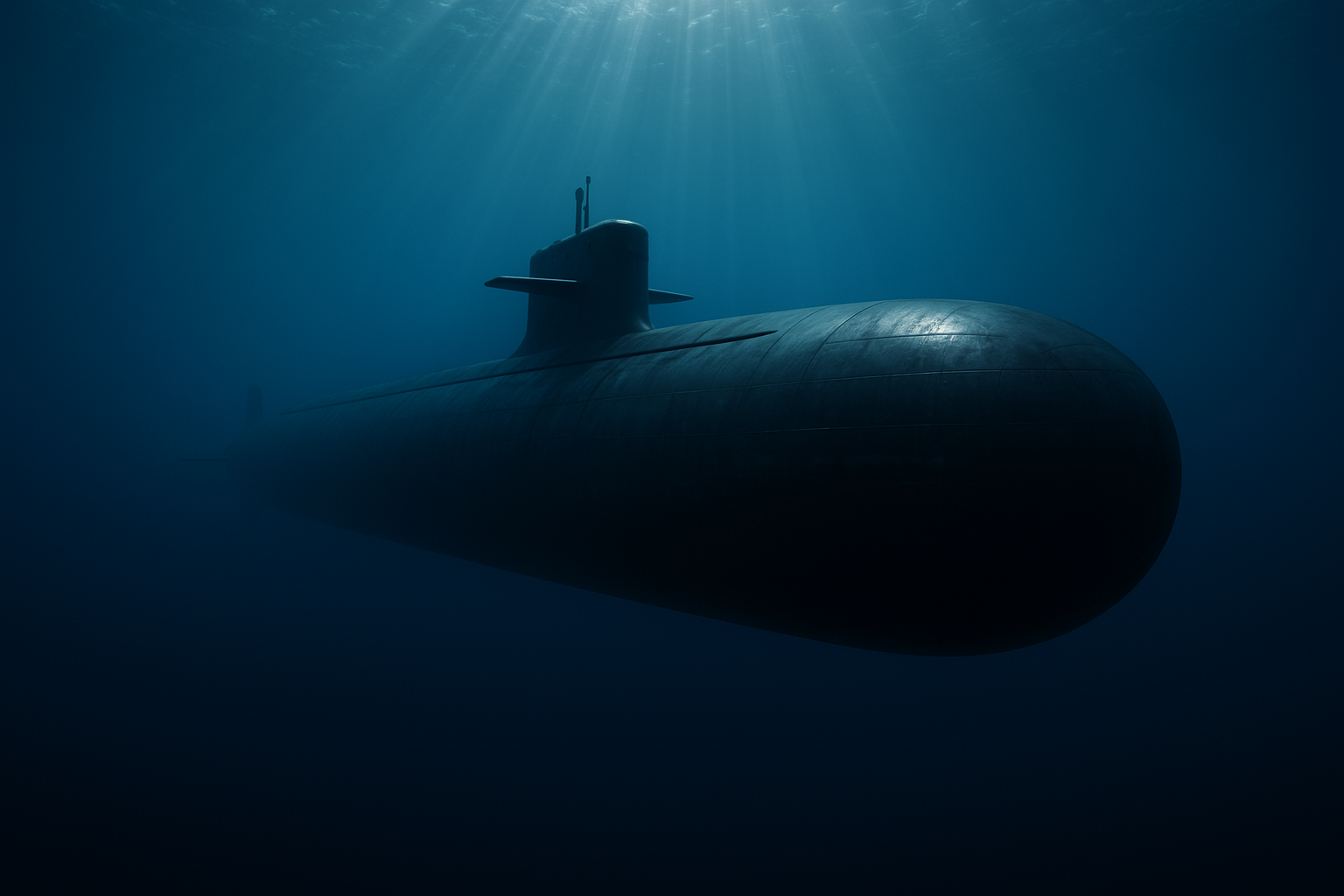
Nuclear Submarines: The Modern Invisible Fortresses of Seas
Nuclear Submarines the most powerful weapon platform sailing beneath waves.
In the Middle Ages, a fort was a towering symbol of strength, security, and supremacy. For centuries, battles raged in and around these strongholds across the world, many of which changed the very course of history. They stood as power centres, allowing nations to display their might and safeguard their existence for generations.
Yet the irony of a fort lay in its design: what made it powerful also made it fragile. Their massive presence meant they could never be hidden; if raised in easy terrain, they offered passage to both defender and attacker alike; if built in forbidding landscapes, they proved as harsh to allies as to enemies. A fort’s greatest strengths were often bound with its deepest vulnerabilities.
Today, those that have withstood the storms of war and the wear of centuries no longer guard kingdoms but stand as guardians of history—protecting the timeless tales of valour, sacrifice, and resilience of all who once fought and fell within their walls.
From Stone Walls to Steel Hulls
Yet in our modern world, the idea of a “fort” has not vanished—it has only transformed. The strongholds of today are not carved in stone but forged in steel, built to dominate the seas and skies. Some have broken free from the curse of immobility, becoming agile and powerful beyond imagination.
The aircraft carrier, for example, is nothing less than a floating fortress, carrying an air force and navy within its decks—though it’s very size still makes it a visible giant on the oceans.
But beneath the waves exists another kind of fort, far more lethal and silent. It carries no towering walls, no banners fluttering in the wind, no trumpets announcing its presence. Instead, it glides unseen, shrouded in secrecy, capable of striking with unimaginable power. If the fort was thunder, this is silence sharpened into steel.
This is the nuclear submarine—perhaps the most formidable fortress mankind has ever created. Unlike the stone bastions of the past, it cannot be besieged or easily spotted. Its strength lies in its invisibility, its endurance, and its ability to carry within its steel hull enough firepower to alter the course of nations.
A Moving City Beneath the Sea
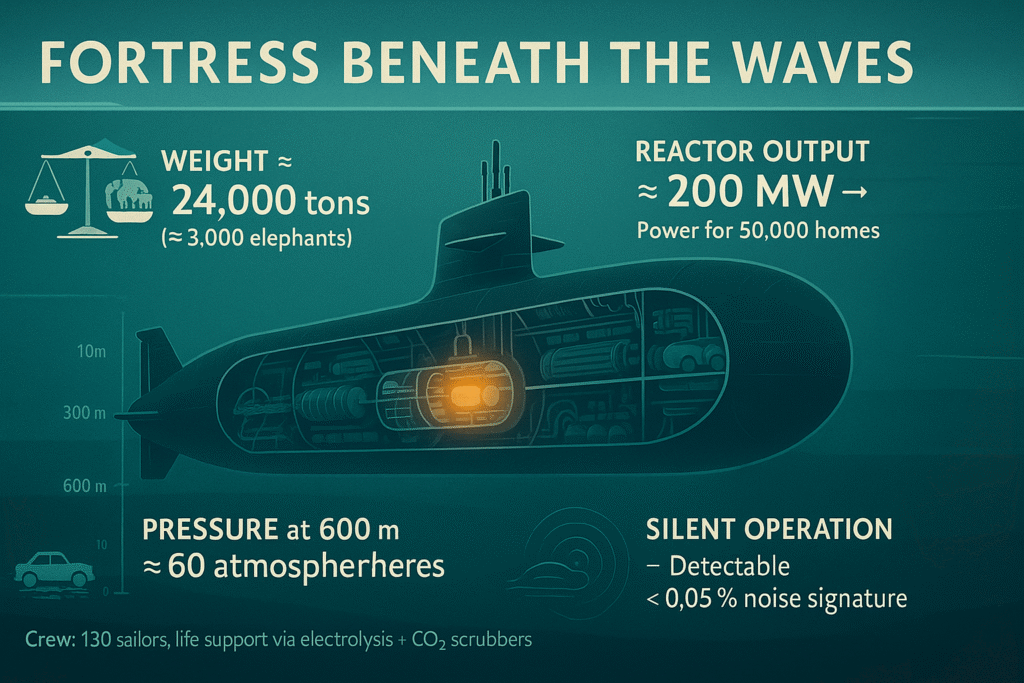
A nuclear submarine is less like a ship and more like a moving city hidden under the sea. Stretching anywhere from 90 to 175 meters across global fleets—such as Russia’s Borei-class (170 m) or France’s Suffern-class (99 m)—it is longer than a football field and, if stood upright, nearly as tall as a 30-storey building. Yet it slips underwater with the silence of a whale.
Its weight runs into thousands of tons—displacement varying from 5,300 tons in China’s Type 093 Shang-class to 24,000 tons in Russia’s Borei-class SSBNs—nearly the same as 3,000 elephants packed together. At depths of 300–600 meters or more, where pressure can crush a car to paper-thin metal in seconds, these giants roam unseen. To understand its resilience, picture a hull so strong that it could bear the weight of 20 jumbo jets pressing down upon it without breaking.
At their core beats a nuclear reactor, a miniature power plant generating 150–200 megawatts thermal—enough to power over 50,000 homes for decades. Fleets from Russia to India rely on this silent heart for limitless endurance, running 20–30 years without refuelling.
And yet, this is perhaps the only place on Earth where humans live just a few inches from a radioactive core. The paradox is striking: the deadliest element aboard is also the one that sustains life—powering the lights, the air, and the engines that carry the submarine unseen through the seas.
The Balance of Science and Survival
Life inside is a careful balance of science and routine. Since no hatch can simply be opened to breathe, seawater is split into oxygen and hydrogen by electrolysis, while carbon dioxide exhaled by sailors is scrubbed away by chemical filters, often using lithium hydroxide that quietly traps the poisonous gas. It is a respiratory system designed not for one person but for an entire community sealed away from the open world. Without these constant, invisible systems working day and night, the crew would not last a single day.
Freshwater too is pulled from the sea, salt stripped out by distillers to fill cups, cook food, and keep the crew alive. Waste is compacted, sealed, and quietly released into the ocean at great depths so that not even a trail can betray the submarine’s position.
Food is perhaps the one true limitation. A submarine can make its own power and oxygen indefinitely, but the fresh fruits and vegetables vanish quickly, usually in the first weeks of a patrol. After that it is canned, frozen, and dried meals until the mission ends. Sailors often joke that the submarine doesn’t run out of fuel or air — it runs out of spinach. Ice cream becomes a morale booster, and chefs are trained not only to cook but to keep spirits high with meals that feel like small celebrations.
Living in such tight quarters means every inch is accounted for. Sailors often share bunks in shifts, one sleeping while another is on duty. There is no sunrise, no night sky, only the soft glow of lights that follow a manufactured day. Exercise is essential; treadmills, stationary bikes, and weights are tucked into corners, so bones and muscles stay strong in a place without fresh air or open ground. Washing clothes or taking a shower is a luxury, carefully rationed — each sailor often gets no more than two or three minutes under fresh water, ironically while surrounded by an endless ocean.
The submarine is not only a home but also a weapon. It carries ballistic missiles in its belly, each with warheads powerful enough to change the course of nations. A single submarine can hold enough destructive power to rival entire countries, and yet it moves silently, hidden from the world above. Its strength lies not just in its arsenal but in the mystery that nobody ever knows exactly where it is.
Silence as a Weapon
Noise, too, is treated like a weapon. On land, the clatter of a dropped wrench is soon forgotten, but in a submarine, it can travel through steel, echo along the hull, and be detected by enemy sonar miles away. A single careless sound can undo what stealth works so hard to protect.
That is why silence is sacred footsteps are soft, conversations subdued, and every machine hums below the threshold of detection. To grasp how elusive these vessels are, imagine trying to find one constantly moving tree inside a rainforest. Nuclear submarines use passive sonar, constantly listening but rarely speaking, detecting surface ships, underwater drones, and even ocean currents — making them both hunters and ghosts of the deep.
Global Guardians of the Deep
A nuclear submarine is the modern echo of the ancient fort: an invisible, mobile stronghold that hides power beneath the sea. NTI
There are two main types:
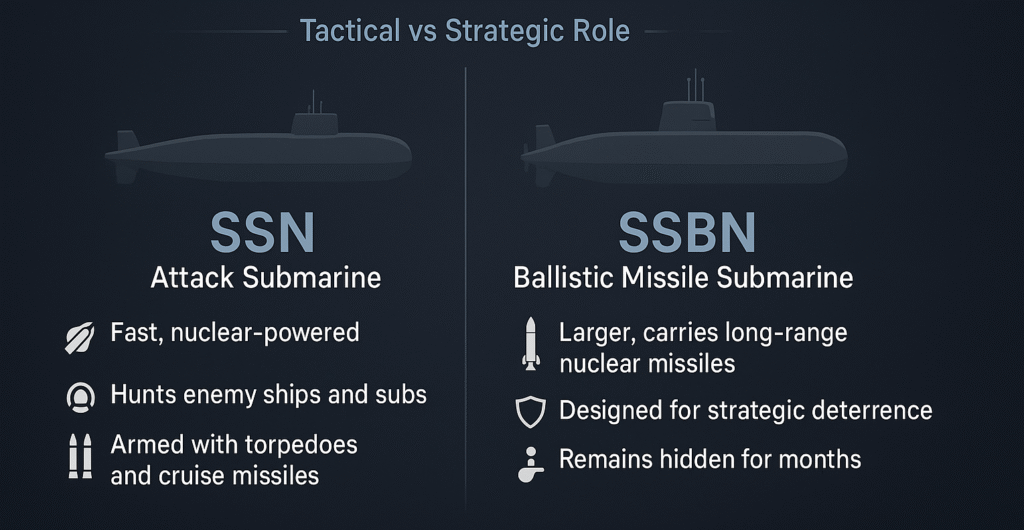
- SSBNs (Ballistic-Missile Submarines) – strategic deterrents carrying nuclear-tipped missiles for second-strike capability.
- SSNs/SSGNs (Attack or Guided-Missile Submarines) – smaller, faster boats for hunting, surveillance, and precision strikes.
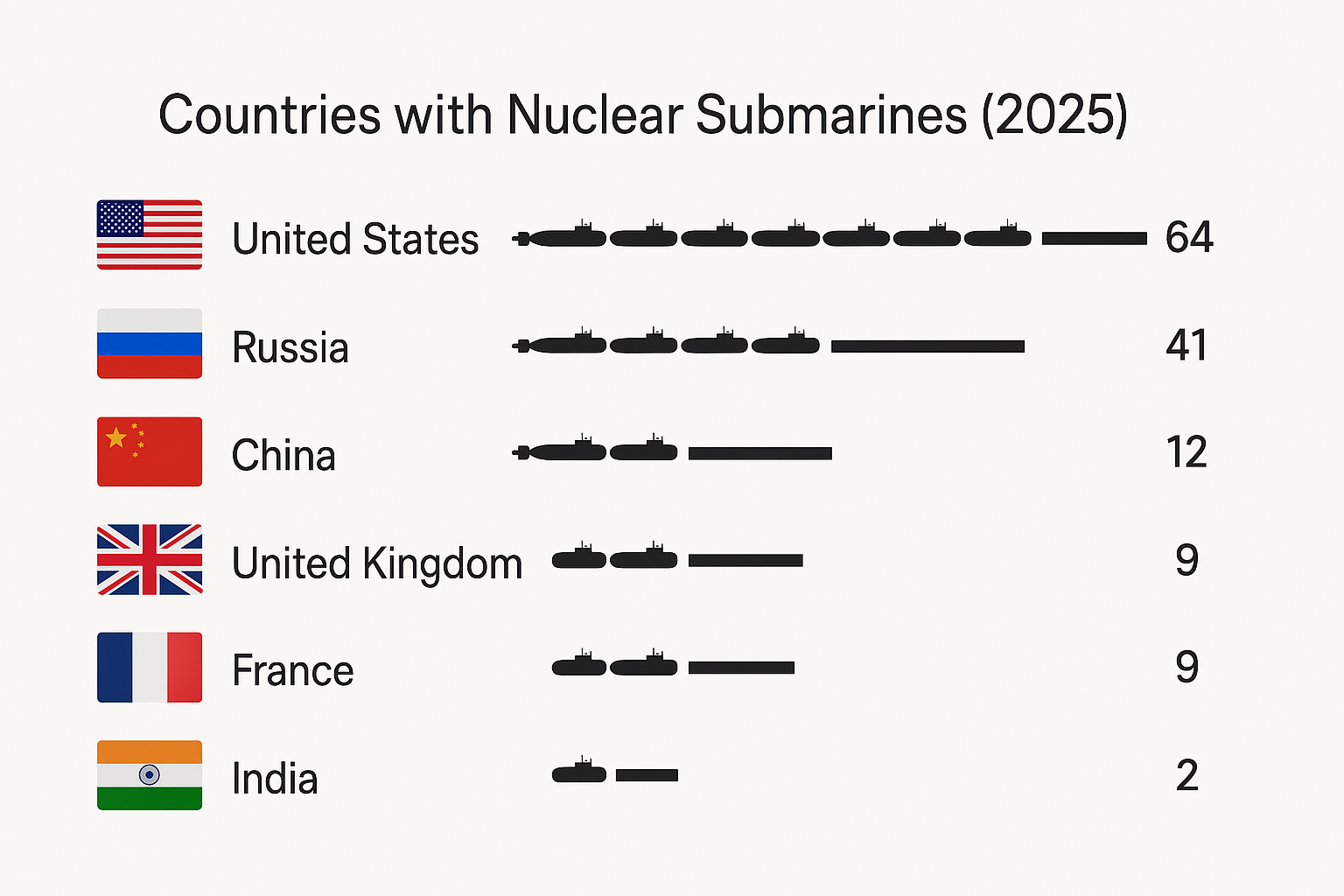
Only a handful of nations operate them:
| Nation | Fleet Highlights (2025) | Focus |
|---|---|---|
| Russia | 41 nuclear subs, including Borei-class (170 m / 24,000 t), Yasen-class (120 m / 13,800 t) | Arctic deterrence, $35.5B spend |
| China | 12+ nuclear subs, Type 094 Jin-class (133 m / 11,000 t) | South China Sea dominance |
| United Kingdom | 9 subs, Astute class (97 m / 7,400 t) | NATO integration |
| France | 9 subs, Triomphant-class (138 m / 14,300 t) | Independent European deterrence |
| India | 2 Arihant-class SSBNs (111 m / 6,000 t), Project 75-Alpha SSNs (planned) | Indigenous nuclear triad, $31.6B program |
| United States | 64 nuclear subs, Virginia-class (115–140 m / 7,900–10,200 t) | Global force projection, $213.9B investment |
| Australia (planned) | AUKUS Virginia-class acquisition ($245B over 30 years) | Indo-Pacific partnerships |
| Brazil (under construction) | French-assisted first SSN, launch mid-2020s | Regional deterrence ambition |
These undersea fleets ensure that no nation can act without consequence. A single SSBN can unleash intercontinental missiles from thousands of kilometres away, while SSNs can strike land targets or trail enemy fleets undetected for months. Statista
The New Strongholds of Humanity
Where medieval forts stood on hills to warn and deter, today’s nuclear submarines disappear beneath the waves to do the same—unseen, patient, and profoundly consequential. They are fortresses with reactor hearts, living crews, and enough endurance to shape geopolitics long after they pass through a patrol sector.
From the roar of cannons to the hum of reactors, humanity’s forts have simply moved deeper.
References: U.S. Navy Fact Files, Jane’s Defence, Naval Technology, The Diplomat, Ministry of Defence (India, UK, France).
For more such interesting information visit Knowledge Center .