

The Deepest Mystery on Earth: Solved?
Mariana Trench earth’s deepest secret.
Did you know you woke up on a slightly different Earth today than the one you slept on last night? Our planet changes a little bit every single day. The shift is invisible within a human lifetime, but over millions of years, it can redraw the map of the entire world.
Earth — our home for over 4.5 billion years — is never static. The only thing constant about it is change.
We humans love to renovate our homes and cities every few years. Earth does the same, only at a geological timescale. About 200 million years from now, today’s continents will look unrecognizable, and every map we know will be outdated.
If you fly non-stop from Sydney (Australia) to Seattle (United States) today, you’ll cover about 12,485 kilometers in nearly 20 hours. But one day — not soon, but someday — you might step from Sydney’s suburbs into Seattle’s downtown in just one stride. Sounds like science fiction? It’s not.
The answer lies deep below the oceans, hidden in one of the greatest geological discoveries ever made. Let’s dive down — into the deepest chasm on Earth.
The Voyage That Changed Everything: The Challenger Expedition
A few centuries ago, people believed the Earth was flat and that ships could fall off its edge. Explorers like Christopher Columbus shattered that myth, proving the Earth was round.
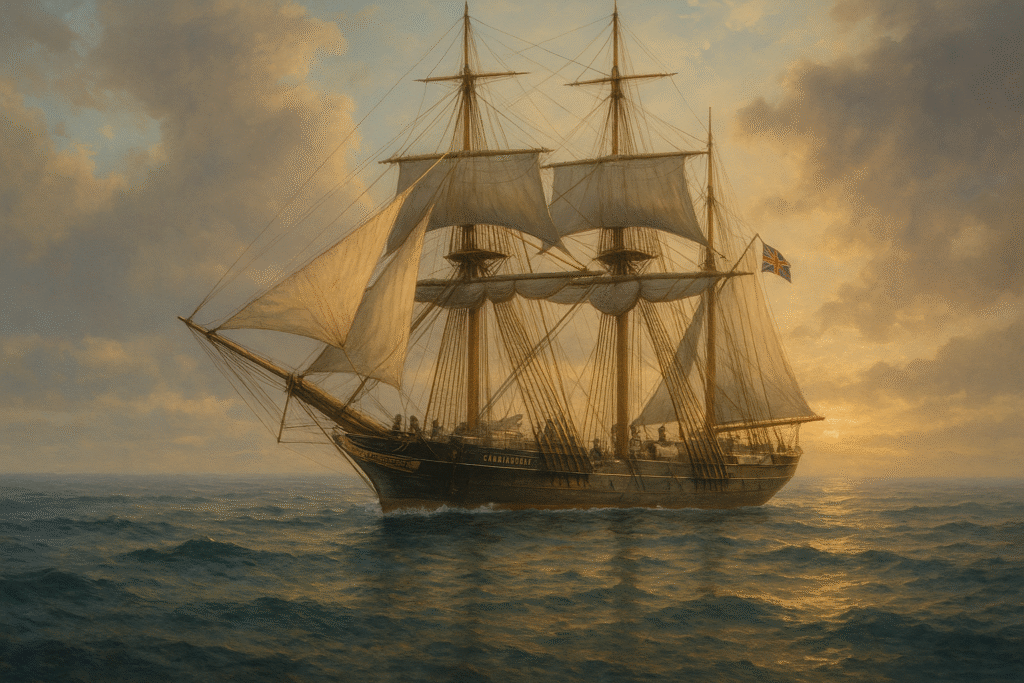
Once humanity accepted that truth, curiosity turned toward the oceans — vast, dark, and largely unknown. In 1872, the British Royal Navy launched a daring expedition: the HMS Challenger. Its mission was to map the ocean floor — the first scientific voyage of its kind.
Over four years, the Challenger sailed more than 112,000 kilometers (about one-third the distance to the Moon), stopping every 225 kilometers to measure ocean depth using heavy ropes with lead weights. It carried an incredible 460 kilometers of rope — enough to wrap around a small country.
Then came a shocking discovery. Near the Mariana Islands in the western Pacific, the crew’s weighted line plunged far deeper than expected — to a depth of 4,475 fathoms (about 8,184 meters).
This revelation shook the scientific world. Geologists, who once believed the ocean floor was flat, suddenly faced a new puzzle: a vast, unseen trench beneath the Pacific.
The Birth of a Mystery: Mariana Trench
By the early 1900s, new tools emerged — most notably, SONAR (Sound Navigation and Ranging). Developed further during World War II, SONAR allowed scientists to map the ocean floor with unprecedented accuracy.
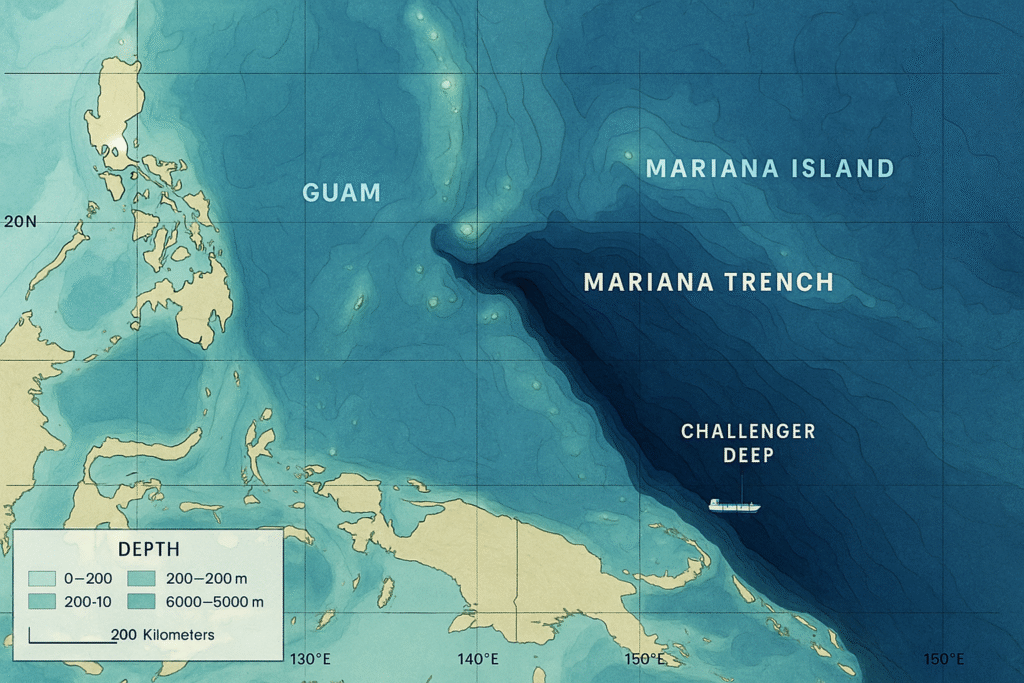
In 1951, the British Navy’s HMS Challenger II set out to re-examine the mysterious spot discovered decades earlier. Using SONAR, the team found that the earlier “hole” was actually part of a massive undersea trench stretching 2,550 kilometres, parallel to the Mariana Islands.
At its southern end, the depth plunged to 10,994 meters (36,037 feet) — deeper than Mount Everest is tall. They named this point “Challenger Deep” in honour of the original expedition.
To put it in perspective: if you dropped Mount Everest into the trench, its peak would still be submerged under 2.1 kilometres of water.
Into the Abyss: The Trieste Dive to the Deepest Point on Earth
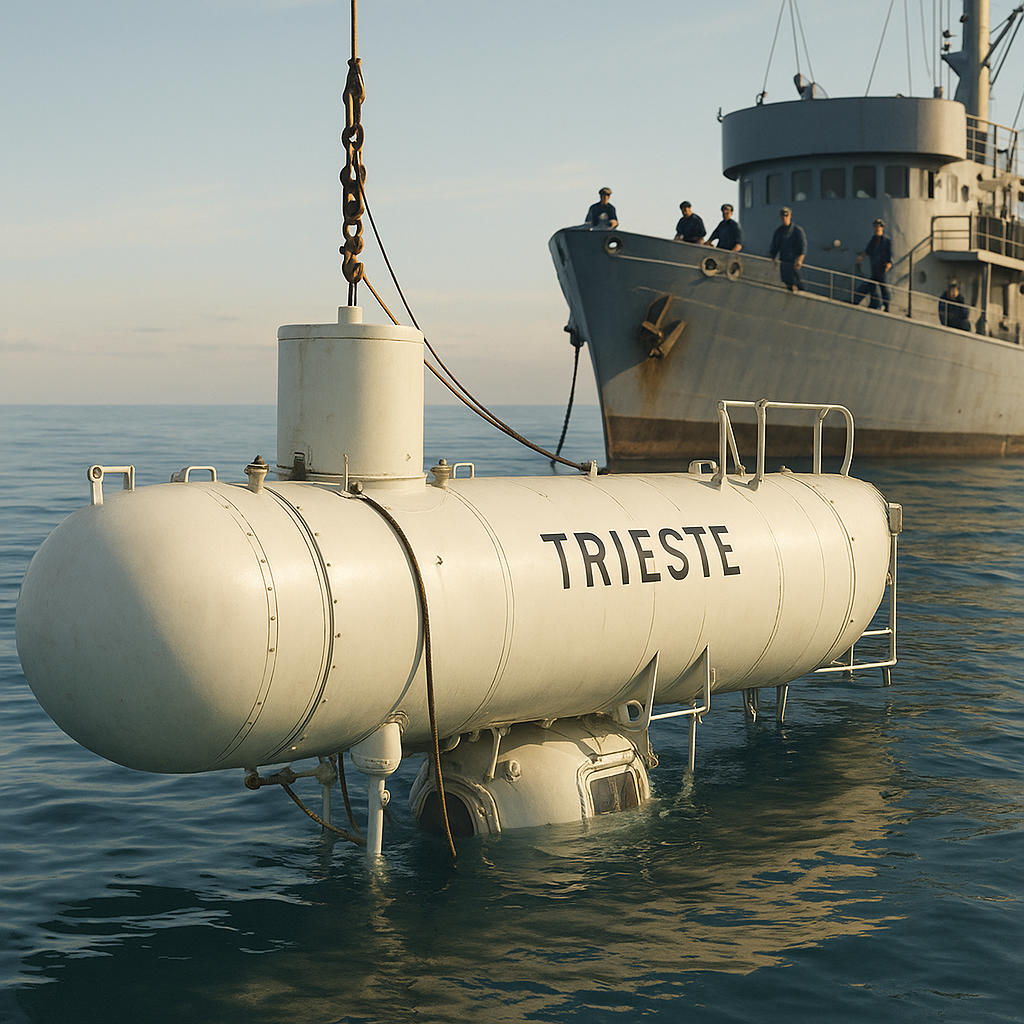
Meanwhile, a Swiss scientist named Auguste Piccard dreamed of visiting this mysterious place himself. In 1953, he began building a deep-diving submersible — a bathyscaphe named Trieste — capable of withstanding the unimaginable pressure of the deep.

At the bottom of Challenger Deep, the pressure is nearly 16,000 pounds per square inch — the equivalent of having 90 blue whales piled on top of you.
After seven years of design and testing, the Trieste was ready. On January 23, 1960, Auguste’s son Jacques Piccard and U.S. Navy Lieutenant Don Walsh embarked on a historic journey to the deepest known point on Earth.
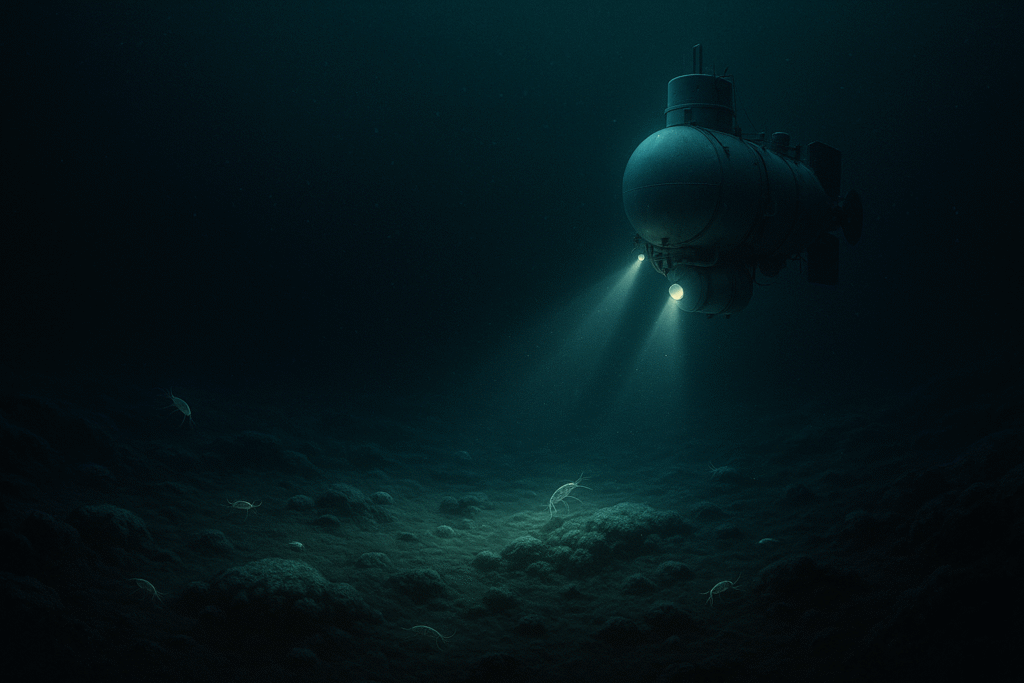
For nearly five hours, they descended slowly through the darkening blue, past layers where sunlight never penetrates. The water grew colder, the light vanished, and the pressure increased with every passing meter. Midway down, they heard a loud crack — one of the outer acrylic windows had fractured under the immense stress. But the steel sphere held firm.
At 10,916 meters (35,814 feet), the Trieste finally touched the ocean floor — the first time in human history that anyone had reached the deepest point on Earth.
They expected to find a lifeless desert of silt, but what they saw astonished them. Through the tiny viewport, they observed flatfish-like creatures about 30 centimeters long and a few small shrimp-like animals drifting in the still water. It was proof that even in conditions of crushing pressure, near-freezing temperature, and complete darkness — life exists.
The ocean floor appeared pale and soft, covered with a fine layer of sediment. No currents disturbed the silence. It was an alien world — Earth’s final frontier.
After spending about twenty minutes observing the abyss, they released ballast weights and began their slow ascent to the surface. The entire dive lasted nearly nine hours.
When the Trieste resurfaced, it carried more than data — it carried a new understanding of life’s resilience and Earth’s mystery.
Geological Formation: The Subduction Zone Secret
The Mariana Trench’s extreme depth stems from its location in the Pacific Ring of Fire, a subduction zone where the denser Pacific Plate is forced beneath the lighter Mariana Plate at rates up to 10 centimetres per year. This tectonic convergence crumples the seafloor into a crescent-shaped chasm stretching 2,550 kilometres and averaging 70 kilometres wide, with Challenger Deep as its nadir at precisely 10,984 ± 25 meters. Formed over millions of years, this process not only creates the deepest ocean trench but also fuels volcanic arcs like the Mariana Islands, tying into broader Pacific geopolitical tensions—link to [your blog post on Pacific Ocean disputes] for more on regional boundaries. Understanding this formation illuminates Earth’s internal engines, connecting surface changes to abyssal depths.
The Deepest Point, the Endless Mystery
Since 1960, only a few others have followed: filmmaker James Cameron in 2012, and explorer Victor Vescovo in 2019, each using advanced submersibles to probe deeper into the trench.
Yet, despite modern technology, much of the Mariana Trench remains unknown. We know more about the surface of Mars than we do about the deepest parts of our own planet.
Beneath eleven kilometres of water, the Earth still keeps its oldest secrets — waiting for us to uncover them.
Did You Know?
- The Mariana Trench is deeper than the cruising altitude of most commercial jets if inverted. NATGEO
- Less than five percent of the ocean floor has been mapped in high resolution.
- The temperature near Challenger Deep ranges between 1°C and 4°C, despite the immense pressure.
Successful Dives to Challenger Deep
Conclusion: Change Is the Only Constant
From shifting continents to deep-sea trenches, Earth is a restless planet — always moving, reshaping, and evolving.
As we dream of exploring other worlds, we must remember: some of the greatest frontiers still lie beneath our own oceans. The Challenger Deep isn’t just a point on a map — it’s a reminder of how little we know about the planet we call home.
Because even after all these centuries, the deepest mystery on Earth is still the Earth itself.
For more such content visit our Knowledge Center.